Ring already writes bytecode with no C compiler involved — Ring++
found that mechanism unused and built a CLI around it. What comes out is a small
pair of files, not a promise wearing a bigger word than it earns.
A program that touches nothing native
Package it, copy the two files to an empty directory with nothing
else present, run it:
$ ringpp build hello.ring --out dist

built  dist
  hello.exe
  hello.ringo

run with:  hello.exe hello.ringo
That is the whole artefact. No installer, no ring.dll,
no Ring install on the target machine at all — verified in this project's own gate
by copying exactly those two files to a clean directory and running them there.
Five platforms — built from whichever one you're on
This is the part Zig makes possible. --target names
where the program will run; it says nothing about where you're
building it. All five combinations work from a single machine:
win64
Windows x64
linux-x64
Linux x64, static musl — one file, any distro
linux-arm64
Linux arm64, static musl
macos-x64
macOS Intel
macos-arm64
macOS Apple Silicon
$ ringpp build service.ring --target linux-x64 --out dist-linux

built  dist-linux
  service
  service.ringo

run with:  service service.ringo
Built on a Windows machine, targeting Linux, with no Linux
anywhere in sight during the build. Not taken on faith: copied to a clean Ubuntu
machine and run there, output byte-identical to running the source directly on
Windows. Package once per target you ship to; nobody on the team needs a second
machine, a VM, or a container to produce any of the five.
A program that reaches native code
ringpp deps names every native library a program can
reach before you package anything — statically, without running it:
$ ringpp deps lib.ring --ring D:\ring127

lib.ring
  load closure : 40 file(s) reached

  Native libraries reachable from this program — these do NOT travel
  inside a .ringo and must exist on the target machine:

    windows            macos                  linux                    declared in
    ring_odbc.dll      libring_odbc.dylib     libring_odbc.so          odbclib.ring:2
    ring_mysql.dll     libring_mysql.dylib    libring_mysql.so         mysqllib.ring:2
    ring_sqlite.dll    libring_sqlite.dylib   libring_sqlite.so        sqlitelib.ring:2
    ring_internet.dll  libring_internet.dylib libring_internet.so     internetlib.ring:2
    ring_openssl.dll   libring_openssl.dylib  libring_openssl.so      openssllib.ring:2
    ring_pgsql.dll     libring_pgsql.dylib    libring_pgsql.so        postgresqllib.ring:2
Point ringpp build at a real install and it bundles
what it can find — never silently. A library it cannot find is named
MISSING in the manifest; the package still works, and says exactly
what it is missing.
The one thing it refuses to package
A program reaching Ring's Qt bridge (ringqt) names
exactly one library by static analysis. Bundling only that one produced a
manifest with no MISSING line — every static measure said the package
was complete.
Copied to an isolated directory and run: no output at all. Windows exit
code 0xC0000409 — worse than a printed error, because it looks
complete right up until it silently is not.
$ ringpp build gui.ring --lib-dir D:\ring127\bin

ringpp build: this program reaches Ring's Qt bridge (ringqt), which
  Ring++ does not package — see DESIGN_BUILD.md sections 3 and 6.
  `ringpp deps` explains why bundling it would be unsafe.
ringqt.dll itself links roughly 75 further Qt
libraries at the operating system's own loader level — a dependency no amount of
scanning Ring's source can see, because Ring's source never names them. Now
refused before a single byte is written, on both ringpp deps and
ringpp build.
Why this is a standing rule, not a one-off
Two reasons, and the first came before the second was ever
measured. Qt is dual-licensed — free under LGPL terms with real obligations
for how a commercial product links and redistributes it, or a paid commercial
licence otherwise. For software shipped to customers, that is a real business
risk, decided against before Ring++ existed. The crash above is the technical
reason underneath the business one: Ring reaches native code through a
scattered shelf of extensions — one ring_*.dll per capability,
each with its own build, its own transitive dependencies, none of it tracked
in one place. The Qt refusal is one instance of a wider, deliberate stance:
Softanza's own Ring foundations aim to depend on nothing beyond what they
vendor and support themselves.
Softanza is not standing still on that either. Its own engine
program — a separate effort from Ring++, in its own repository — has spent five
milestones replacing exactly this shelf: uuid.ring,
fastpro.ring, html.ring, libcurl.ring and
libuv.ring are gone from Softanza's own base library, each closed out
with a Zig-native module in their place.
87
Zig-native modules shipping in Softanza's own engine
0
Qt dependencies left — fully purged
5
external Ring extensions closed: uuid, fastpro, html, libcurl, libuv
1,593
engine tests passing
Ring++ does not ship that engine — it is
Softanza's own project, further along a road Ring++'s own measurement (the Qt
crash above) confirms is the right one to be on. Two independent efforts, the
same direction: fewer scattered native dependencies, not more.
The trip inside Ring, if you want it
Run ring yourfile.ring -go on stock Ring, today,
and it writes yourfile.ringo — a compiled form of your program.
Run ring yourfile.ringo, and it just runs, no compiler involved
at any point. This has always been true; it's how Ring itself starts up
fast. Ring's own packaging tool, ring2exe, takes a different
route from there — it writes a C file and hands it to Visual C++, GCC or
Clang. ringpp build takes the other fork: it keeps the
bytecode Ring already writes, and attaches a small prebuilt copy of Ring
itself that knows how to run it. Nothing new was invented. Two doors were
already open in Ring's own design; this project just walked through the
second one. The fuller design story is its own
page, alongside the other two doors and the contract that keeps this
working as Ring evolves.
And it runs on a phone
Mobile is usually where a small language's packaging story
ends. The standard route asks you to install Qt, install Qt Creator, let a
tool prepare a Qt project, and then build that project — a toolchain far
larger than the program going through it. Ring++ takes none of that road.
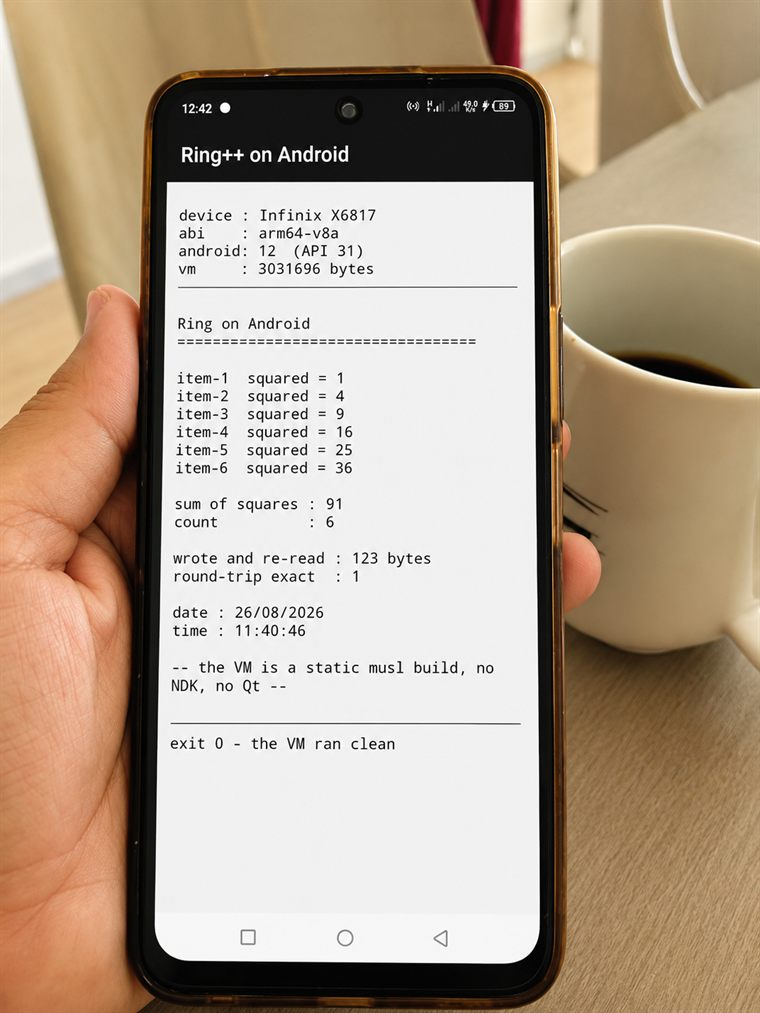
The runtime it already ships for Linux ARM is, unchanged, a runtime Android
will run: the VM is a plain bytecode interpreter, it never asks the system
for executable memory, and so nothing about a locked-down phone objects to
it. The photograph below is that runtime, on a phone, doing real work.
A Ring program running as an Android app on an ordinary phone.
Lists, a class holding state, a file written and read back exact.
One command builds that:
ringpp build app.ring --target android, and out comes a signed,
installable .apk. No NDK, no Qt, no Qt Creator, no Gradle, no
JNI, no C compiler. The Ring runtime inside the app is byte-identical
to the one the Linux build ships — it isn't a port, it's the same file.
Android is the one target that does ask something of you: an
Android SDK and a JDK, because only Google's own tool writes the manifest
format Android reads. That is said plainly here because the command says it
plainly too — without them it tells you which one is missing and stops,
rather than handing you an app that installs and then dies.
Which packaging tool should you actually use?
Ring has three, and they answer different questions rather
than competing. Ring2EXE ships with Ring and is the only one that
reaches the browser, and it reaches mobile the Qt way, by preparing a Qt
project for you to open in Qt Creator.
Ring2EXE++, Youssef Saeed's extended tool, is by far
the strongest at distribution — ten installer formats, from
.deb to MSI, plus auto-detection and presets. Nothing here
approaches that. ringpp build is the only one that
needs no C compiler on any machine and cross-builds five platforms from
whichever one you are sitting at — and the only one that reaches Android
without Qt.
The full comparison — read from each tool's own source,
with the mobile and WebAssembly situation measured rather than asserted, and
a map of which sibling project covers which target so nobody duplicates
work — is BUILD-OPTIONS.md.