How RingScript started
RingScript began with a need. I build business software in Ring, and it handles everything the work asks of it — except the part that runs in the browser.
Software with real users
The applications came first, and they were never demos: in Niger, for a bank and for a high school; in France, for a restaurant. Different places, different trades, one shared reality — the rules matter, the connection is not guaranteed, and the software has to keep working long after the excitement of building it.
Softanza, then StzWeb
Two things grew out of that work.
Softanza
The foundation: a library and the engine beneath it, so Ring code can say what it means without paying for the elegance at runtime.
StzWeb coming soon
An opinionated, deliberately simple web framework for business applications — built on plain web standards, made to run offline. Still in progress; it will be published soon.
The one part that was missing
Ring already handles the server side. But the moment a page needed logic, the answer was always JavaScript — a second language, a second way of thinking, for the same application. My colleagues did not enjoy that part, and honestly, neither did I.
So I put the Ring virtual machine itself in the browser, compiled to WebAssembly, and announced the first working editor to the Ring community.
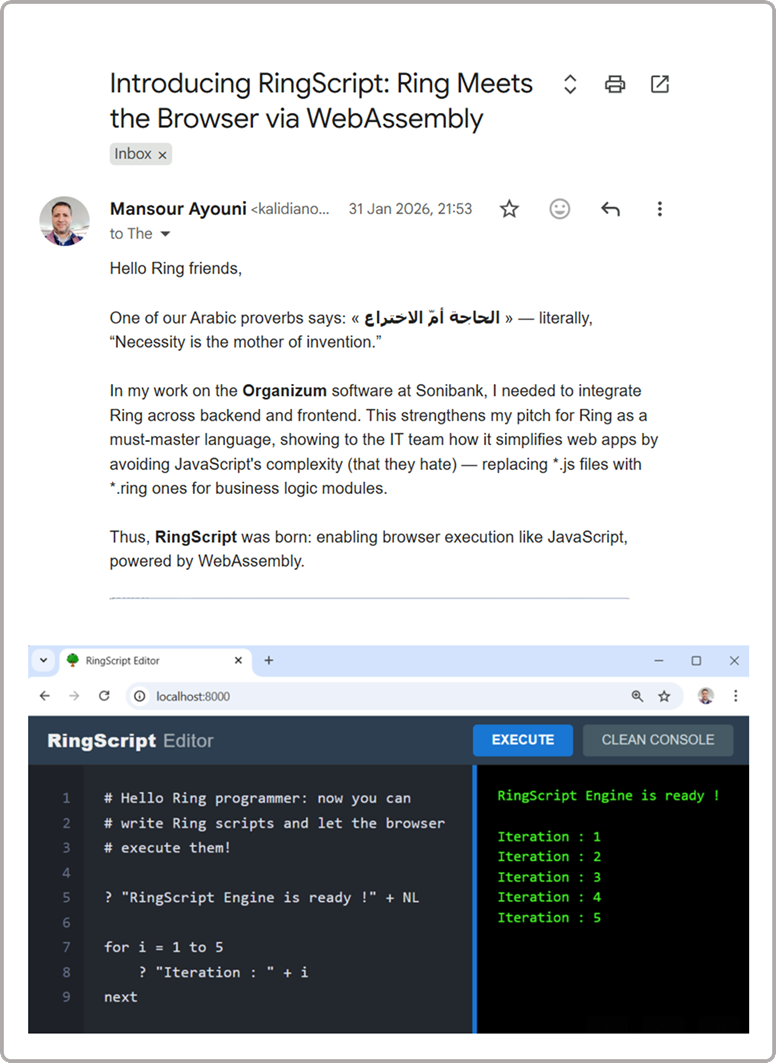
Where it stands
What began as a prototype is now version 0.9: verified program by program against native Ring, and used in the applications that prompted it. Version 1.0 will come once Softanza and StzWeb have caught up with it in production.
If you write software for people who need it to work — offline, predictably, for years — you are welcome to it.

Creator of the Softanza library for Ring, and of StzWeb and RingScript. Building business software that has to work where it is needed.