One static binary with everything inside: the web server, the Ring
language, a SQL database, a JavaScript engine. Write clear, readable services.
Nothing to install, nothing to configure.
version 0.9one file per platformzero dependenciesMIT
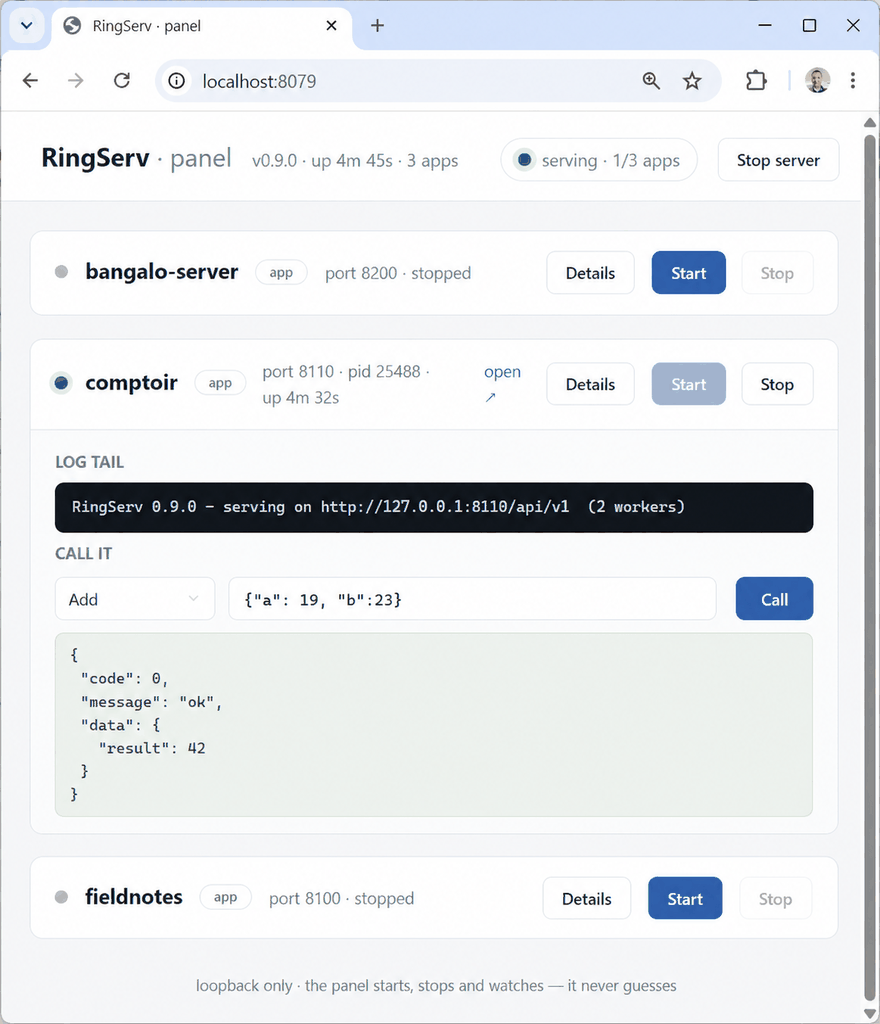
The admin panel: every application in one place — start it, stop it,
watch its log, and call any action right from the browser. It ships inside the
same binary: ringserv panel .Start here
The same service, two ways
A greeting endpoint: read a name, default it, answer politely. Below are the
two versions of the very same service — line for line, same length, same order — so the only
thing that differs is how the logic reads.
The JavaScript version starts from npm install express and a
node_modules directory; the Ring version starts from one downloaded file.
Node + Express13 lines
require the framework, wire the route, parse the body
const express = require("express")
const app = express()
app.use(express.json())

app.post("/api/greet", (req, res) => {
    let name = req.body.name
    if (!name) { name = "stranger" }

    res.json({
        message: "Ahlan, " + name + "!"
    })
})
app.listen(8080)
Ring13 lines
declare the service, name the action, say what you mean
No routes to design, no verbs to choose, no body
parser to remember: every service answers at /api/v1 as
service.action(payload) — the same call shape RingScript pages already speak.
That is the whole trick — and it holds as the application grows.
What you get
◉
A whole backend in one file
The web server, the Ring VM, a SQL database and a JavaScript engine, compiled
into one static binary per platform. Install is: download it, run it.
◈
Errors that don't kill the server
A mistake in a service returns a clean answer with its real line number, and the
server keeps serving. Thousands of hostile requests later, memory is still flat.
⇆
Two languages, one application
A service can be a .js file. It follows the same rules as a Ring one,
and each side calls the other by name. The seam is thin — and optional.
❐
A database already inside
Describe your tables, write ordinary SQL, and say what each request must contain —
bad requests are turned away before your code ever sees them.
⧉
History that cannot be edited
A journal you can only add to. Each entry is sealed with a fingerprint of the one
before it — if anyone edits the past, the server points at exactly where.
✦
Pages that work offline
Declare where each service and table lives — page, server, or both with sync.
Move one between them by changing a word, not the application.
One file, many homes
The same application runs wherever a file can run: Linux, macOS and
Windows servers, a laptop under the counter, or a small ARM board like a
Raspberry Pi — one downloaded file each, nothing to install around it.
Already a Ring programmer? ringpm install ringserv from mayouni brings
the binary, the guides and both examples in one step.
Mobile phones are next on the public plan,
and so is deploying agents — long-running workers with journal-backed memory,
the hosting side of Softanza Programmatic Agents. The plan is public precisely so you can see
what is real today and what is next.
Putting it up is one command. Changing it is one more.
ringserv deploy ./myapp puts an application up, with your
data kept in a separate folder beside the code. ringserv redeploy myapp
replaces the code and keeps the data — and if it is running, the change goes
live at once. There is no downtime and nobody using it notices: the server picks up
your new code in about 60 milliseconds without restarting or letting go of
its address.
Your data is safe there not because a redeploy is careful, but because
a redeploy cannot reach it — it replaces everything except the folder your
records live in. No setting to get wrong, which matters most at the moment you are
least careful. How deployment works.
One programming model, two players
RingScript runs Ring in the browser; RingServ runs the same VM on the
server — and both speak the same service.action(payload) call. Declare
your services once, and move one between page and server by changing a single word.
Offline-first sync included.
"It runs Ring" is checked, not claimed — against the native
interpreter, on three platforms, on every change. The losses are
published
with the wins.
~970
programs verified byte-identical to native Ring
625
tests, run on Linux, macOS and Windows, every change
5,700
requests per second at peak, four VM workers, release build
1.27
Ring version inside the binary
Honest limits
For HTTPS, put a proxy in front — RingServ refuses a public address
until you confirm one is there. A few features are deliberate subsets that refuse the
rest by name. And 0.9 means ready to use, not finished. Each of these has its plain
answer in the Q&A.
Standing on named shoulders
One binary, zero dependencies — because the dependencies are inside,
vendored and pinned, and their authors deserve their names on the front page:
Mahmoud Fayed and the Ring team's
Ring VM — the heart of
the whole thing; Youssef Saeed's
tree-sitter-ring
grammar, which powers ringserv check; Karl Seguin's
http.zig
server core; D. Richard Hipp's
SQLite; the
QuickJS-ng
engine descended from Fabrice Bellard's QuickJS; and
Andrew Kelley and the Zig team's
Zig language and
toolchain, which compile them all into one file. The exact pinned versions are in
vendor/VENDOR.md.