

The north star
In 2020 the author drew Softanza on one sheet, in six bands, from the people it serves down to what it stands on. In September 2026 the sheet was read again, band by band, against what had been built. The goal has not moved. What carries it has.
The sheet of 2020
The sheet is titled "Softanza — Programming by heart!". The project is older than its drawing: it began in 2018, and the sheet is how it saw itself two years later. Its six bands, from top to bottom:
- Who it is for. Programmers alone or in small teams, first. Then functional and data analysts; interface and experience designers; technical leaders, governments, start-ups and businesses; educators, linguists, authors and knowledge architects.
- Solutions. A software model, a delivery model, an enterprise model.
- Systems. Technical, social, ecological, economic and cultural: five dimensions every solution answers to, not one.
- Narrations, "a computational thinking framework: what you think is what you write". Natural language that executes, natural expression and conversation inside the code, knowledge represented inside the code, and a manifesto.
- Foundation, "an accelerative library for any algorithmic need". A great programmer experience and documentation, an intuitive mental model that can be learned, a layered design driven by goals.
- Beneath. The scripting language of the time, the force of low-level code, and other languages later.
Read in 2026
Each band was checked against the repositories, with the places named so the check can be repeated. The verdicts, in one line each:
- Who it is for: kept, and one reader added. Every audience has a real instance today. The reader 2020 could not draw is the AI agent, which now both builds and speaks the languages, held to their grammar.
- Solutions: kept, renamed, sharpened. The software model is the open platform; the delivery model is how a solution reaches its users, one world at a time; the enterprise model is the commercial layer over the same plain text: the workbenches where the model meets a trade, and the assurance behind the foundation. One path joins them: declare your first language free, then compose an application, federate an organisation, govern how it changes, and each step upgrades the same files.
- Systems: kept, and under-used. Each of the five has a practice, from frugal hardware to the rule that the customer owns code and data. No solution yet writes them down as five rows; that is the next step, not a claim.
- Narrations: kept in promise, changed in mechanism. Natural language stays at the door, where it asks and drafts. Execution moved into small declared languages that a court can judge, because a natural sentence can be ambiguous and a lie can be grammatical.
- Foundation: kept, and the library became a corpus. Twenty-eight areas, 575 classes and 501 scenario guards, where 2020 promised "a library". The direction now is one binary with its organs, from the runtime to the narrator, and the library's guards are the instrument that judges every module that moves.
- Beneath: superseded, in the direction it pointed. The platform now owns the floors it stands on: Haro, its language, in construction; Harobanda, the declared machine, built; and the device beneath it.
The Softanza way A vision is read against what exists, band by band, and every verdict names where to check it. A promise that changed its mechanism says so instead of claiming it was always meant that way.
The sheet, redrawn
The same six bands, with what carries each one today, and the court that sits beside all of them. Two things are new since 2020: the agents in the first band, and the floors beneath.
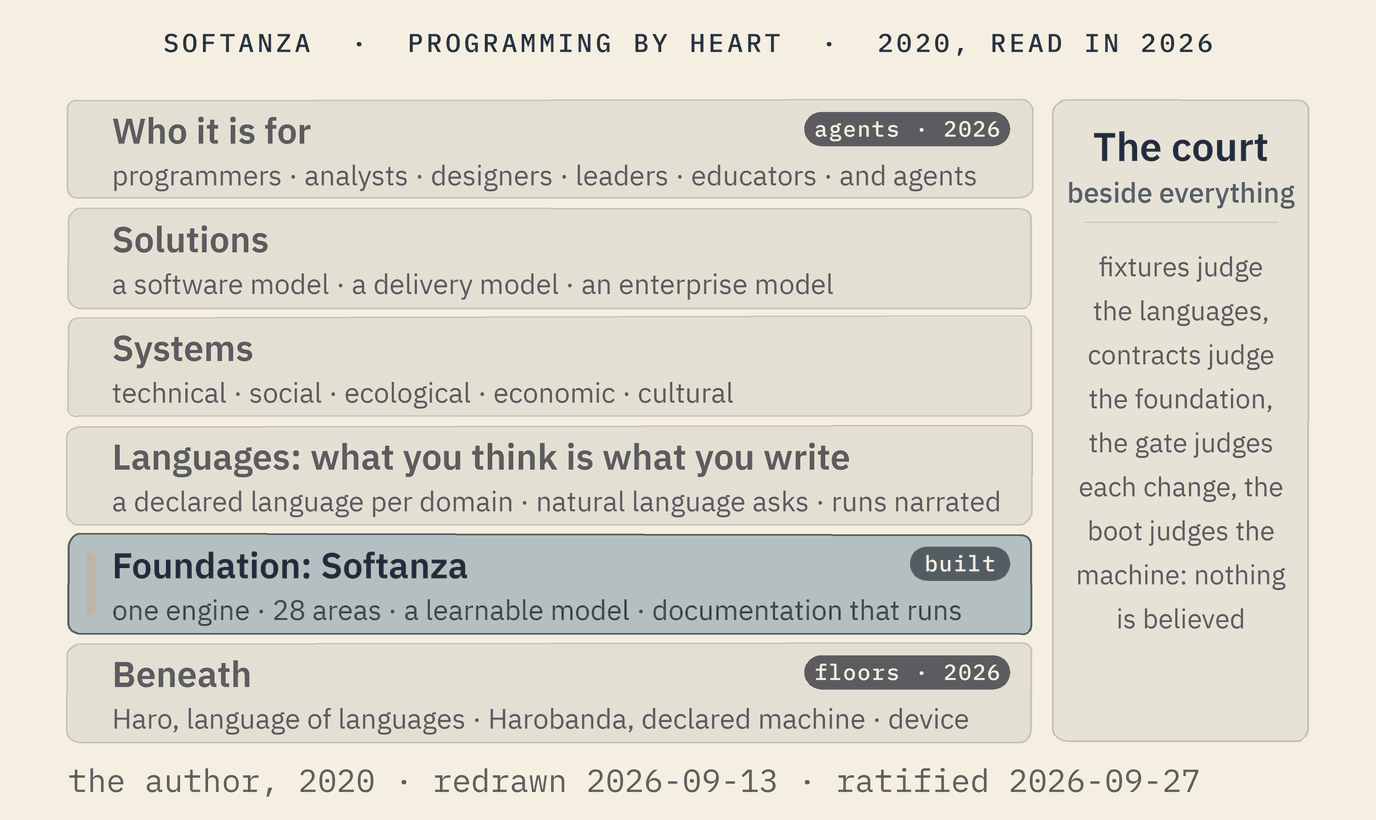
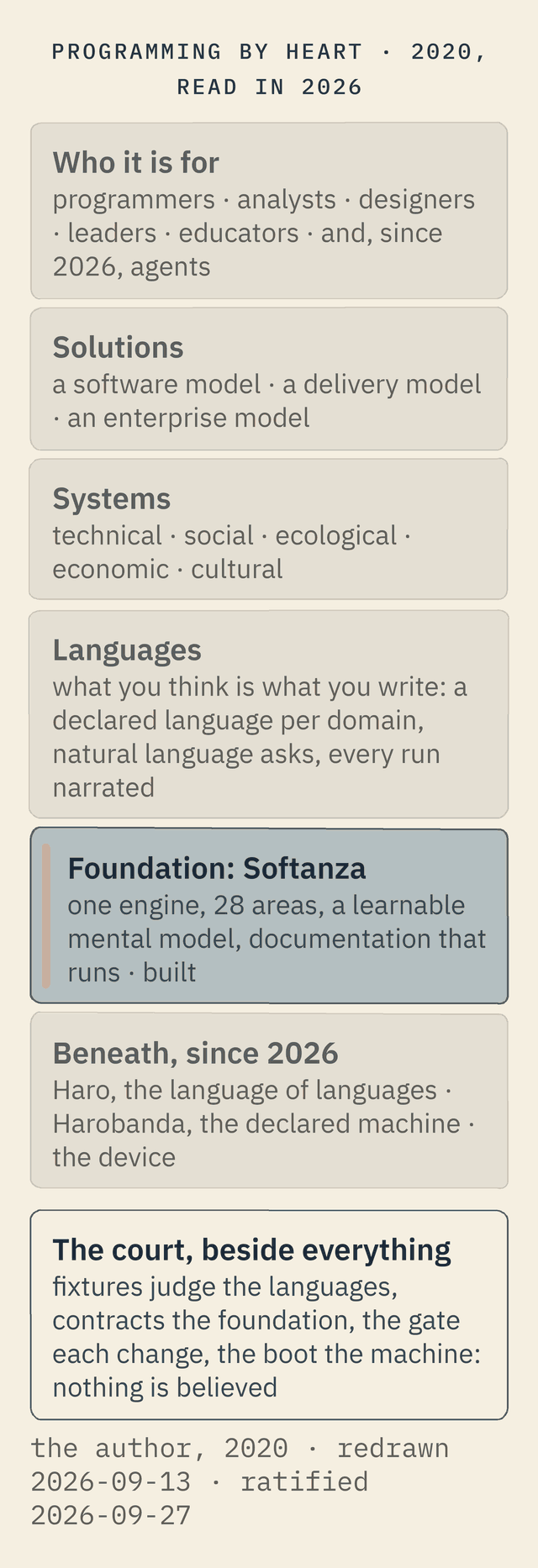
The mission is the one of 2020: programming by heart, an inclusive path from an idea to a working system, whatever your background. What 2026 adds is the sentence that makes it safe when machines write too: everything is a declaration, every declaration is judged, and the machine it all runs on is declared the same way.
What must not change
- The first reader stays the programmer in a small team. The agentic age did not replace that person; it multiplied them.
- Programming by heart. The court is severe so that the surface can stay warm: the narrations, the plain words, a tutor that asks rather than answers.
- The refusal of complexity. No real-time system of its own, no shell on the declared machine, no store, no single repository of everything, one governed door for foreign code. Every refusal in the estate is the same refusal.
- Sovereignty, as a definition and not a mood. Nothing anyone else can withdraw, decided dependency by dependency.
- Honesty about scope. "Built", "in construction", "named": each word can be checked, on this site as in the repositories.
Source: chapter 8 of Softanza's vision corpus, "The North Star: the 2020 diagram, read in 2026", ratified by the author on 27 September 2026. The corpus itself is not public yet; every repository it cites for a public part of the platform is linked from the page that describes that part.