

Wise coding, against vibe coding
Wise coding is the name of a practice, not of the platform: the platform asks the question the person has to answer, and refuses to guess the answer. Expression is free; admission is governed. "Vibe coding" is the inverse, prompting an AI model and keeping whatever comes out.
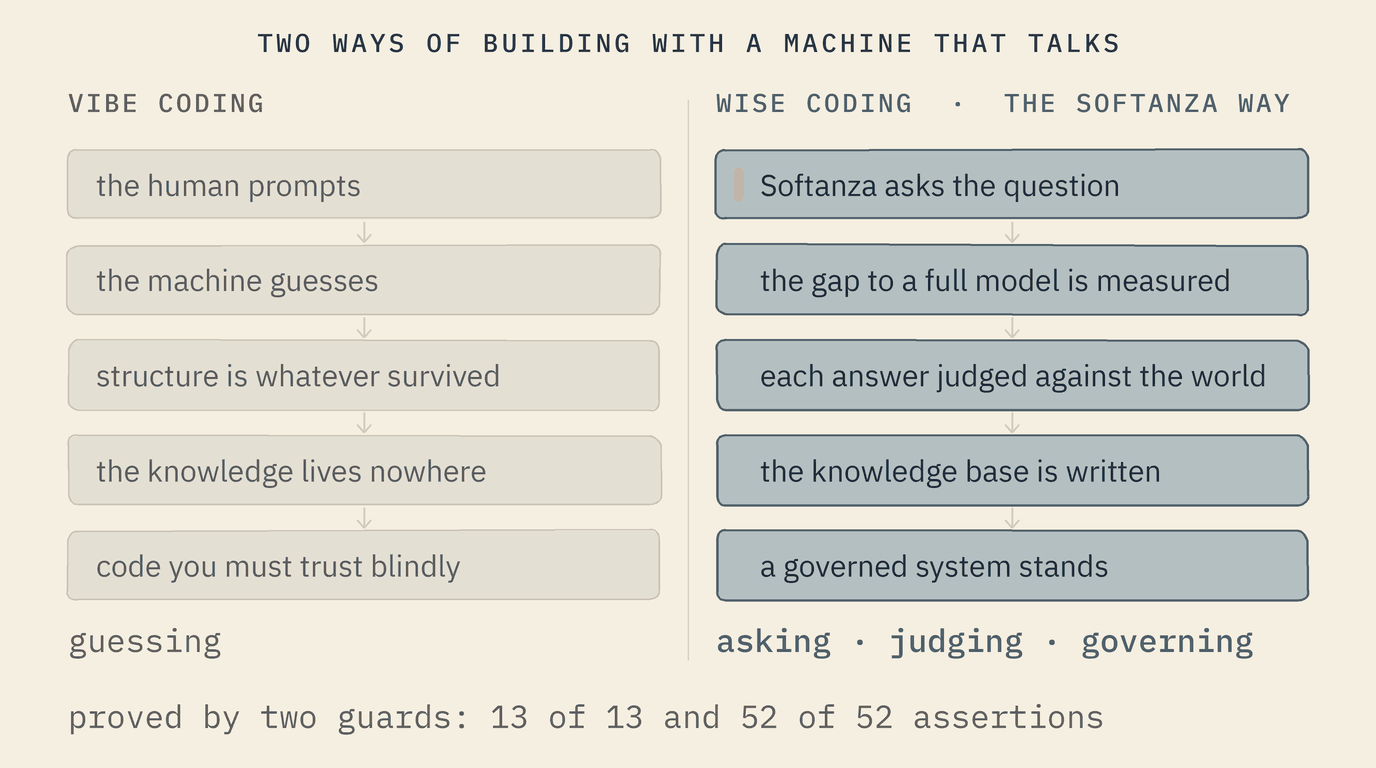
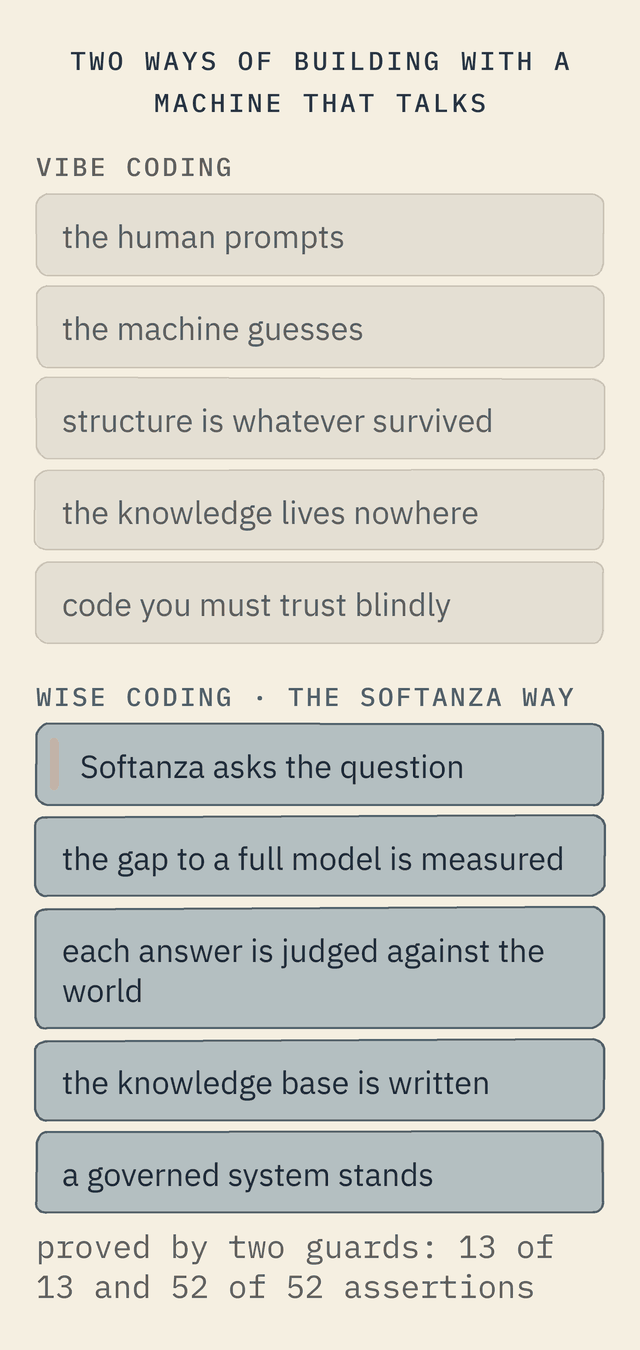
In vibe coding the human prompts and the machine guesses. Structure is whatever survives the guessing; the knowledge lives nowhere; the result is code you must trust without a brain behind it.
In wise coding it is Softanza that asks the user. The system knows what a complete domain model requires, because the ontology and the rules define the target shape. It measures the gap between that shape and what it has heard so far, and turns each gap into the next well-structured question.
An answer may come in five registers: a choice among options, a data structure, a formula, a sentence in natural language, or examples. Every answer is checked against the world graph: one acceptable reading is accepted; several are listed for the user to choose; none is refused, with the nearest alternatives. The session ends with real artefacts: the knowledge base written, the data in place, an operational system standing.
-- Scene 4: the session ends by WRITING the knowledgebase --
  [OK] gaps closed
  [OK] Conclude writes the SPACE as .zknw
  [OK] the transcript reads as dialogue
  [OK] the conversation persists (*.stzconv)
  [OK] concluding with open gaps REFUSES (LAW 3)
TOTAL: 13 assertions, 13 pass, 0 fail
run on 2026-10-01 at 09:39: wisecoding_narrated(opens in a new tab) (13 of 13) and wisecoding_rich_narrated(opens in a new tab) (52 of 52), each in about three seconds; the doctrine is section 0.3 of SOFTANZA_INTELLIGENCE_ARCHITECTURE.md(opens in a new tab)
The Softanza way Expression is free, admission is governed. Guessing is replaced by asking; vibes are replaced by governance.
The fifth register, an answer by example, is told on its own page: by example.