

Probabilistic Quantifiers in Softanza: Natural Proportions Meet Logical Precision
Softanza introduces probabilistic quantifiers like Few(), Some(), Most(), and All(), allowing for more intuitive data manipulation by reflecting natural language. These quantifiers map conversational terms to precise proportions, making code both expressive and clear.
by Mansour Ayouni · in the repository since 2025-01-13 · feature essay · area Numeric & optimization

A continuous path leading toward a grand pyramid structure.
Basic Examples
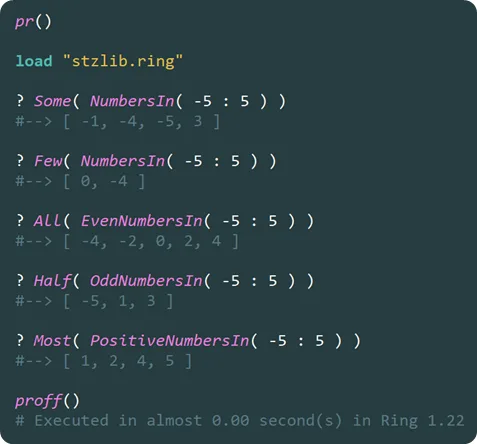
Here’s how these quantifiers can be used in practice:
load "stzlib.ring"

? Some( NumbersIn( -5 : 5 ) )
#--> [ -1, -4, -5, 3 ]

? Most( PositiveNumbersIn( -5 : 5 ) )
#--> [ 1, 2, 4, 5 ]
illustration
Each probabilistic quantifier corresponds to a default proportion of items:
- Few() → 10%
- Some() → 30%
- Most() → 90%
You can also customize these proportions using commands like SetFew(0.15) or SetMost(0.85).
The Probabiliistic Continuum
These quantifiers form a continuum:
No() → Few() → Some() → Half() → Many() → Most() → All()
They’re especially powerful when used in probabilistic and random contexts, like so:
SetSome(0.4)

? Some( RandomNumbersIn(1:10) )
#--> [ 5, 2, 7, 9 ]

? Few( RandomNumbersInU(1:10) ) # "U" for Unique items
#--> [ 1, 4 ]
illustration
For completeness, the All() and No() quantifiers are straightforward:
- All() returns all items in a list.
- No() returns an empty list.
Example:
? All([ "A", "B", "C" ])
#--> [ "A", "B", "C" ]

? No([ "A", "B", "C" ])
#--> []
run on 2026-10-08 20:42 at commit 4a184e6f0: kept its promise
A Sense of Semantic Beauty
For semantic convenience, alternative function names like AllOf(), NoOne(), and NoOneOf() are provided, making the expressions more natural:
Them = [ "Andy", "Bill", "Chris" ]

? AllOf(Them)
#--> [ "Andy", "Bill", "Chris" ]

? NoOneOf(Them)
#--> [ ]
run on 2026-10-08 20:42 at commit 4a184e6f0: kept its promise
Softanza also supports fluent forms of these functions, which can enhance code readability. By using the Q() suffix, we get more natural expressions:
MyExamNotes = [ 12, 17, 18, 16, 19 ]
Them = MyExamNotes # Semantic alias for clarity
Average = 10

? AllOfQQ(MyExamNotes).ArePositive()
#--> TRUE

? AllOfQQ(Them).AreGreaterThan(Average)
#--> TRUE
illustration
NOTE: The
Q(aList)function promotesaListto astzListObject, andQQ(aList)promotes it to a specific type of Softanza list, likeQQ([1, 2, 3]), which returns astzListOfNumbersobject. This allows the use of specialized functions likeArePositive(),AreGreaterThan(), etc.
Logical Magic with Quantifiers
I'll show you the case of NothingIn() quantifier, which is an exact alternative of the No() quantifier we saw earlier.
I’ll prefix it with QQ() because I’m working with a list of email addresses and want to promote it to a stzListOfStrings object to check the emails against a regular expression pattern using the Macth() function.
Now, here’s where it gets even more exciting—I’ll add the magical X() suffix!
The X() suffix offers a powerful mechanism to express logical statements declaratively and verify them directly. In this case:
- NothingInQQX() checks whether none of the elements in the list satisfy a condition.
- EverythingInQQX() checks whether all of them do.
Here’s an example of how it works:
? NothingInQQX([ "aee@net", "@com.com", "--?mail@org" ]).MatchesX(rxp(:eMail))
#--> TRUE  # No element in the list matches the email pattern.

? NothingInQQX([ "aee@net", "@com.com", "--?mail@org", "info@mail.com" ]).MatchesX(rxp(:eMail))
#--> FALSE # At least one element matches the email pattern.

? EverythingInQQX([ "hello@mail.com", "info@mail.org" ]).MatchesX(rxp(:eMail))
#--> TRUE  # All elements match the email pattern.

? EverythingInQQX([ "hello@mail.com", "info@mail.org", "~;@com" ]).MatchesX(rxp(:eMail))
#--> FALSE # Not all elements match the email pattern.
illustration
This approach combines intuitive expression with precise logic, allowing for clear and concise condition validation.
NOTE: The
rxp(:email)utility returns the regular expression pattern for a valid email:"^[a-zA-Z0-9._%+-]+@[a-zA-Z0-9.-]+\.[a-zA-Z]{2,}$".
Conclusion
Probabilistic quantifiers in Softanza enhance coding fluency, bridging the gap between natural language and precise logic. They enable expressive, easy-to-read code while still maintaining the power of rigorous validation.
See them in action in Haro Notepad hereafter:
Cite
Mansour Ayouni. "Probabilistic Quantifiers in Softanza: Natural Proportions Meet Logical Precision". Softanza narrations, 2025. https://mayouni.github.io/stzsite/en/narrations/stz-probabilistic-quantifiers-narration.html
Run in Haro's name on 2026-10-08 20:42 inside the library at commit 4a184e6f0, block after block in one process: 2 of 6 blocks kept their promise; the others are illustrations. The code of the articles is Haro code. Where an article was written before the language took its present name, the name was changed and nothing else. Genre, area and series read from the file's name, the year from its first commit: derived, until the article carries its own header. The file on GitHub(opens in a new tab)