

Concurrency & distribution
Excellent substrates: nodes, supervision, multicore, fleet; the unifying vocabulary is design-only.
6 Strong · 4 Solid · 1 Partial · 1 Emerging
Measured against: Go · Akka · Erlang/OTP · Ray · Folders: base/concurrent(opens in a new tab) · base/cluster(opens in a new tab) · base/network(opens in a new tab) · For programmers: this area's reference
Rethought from first principles
What Softanza kept from what works, and what it rethought, as the library wrote it down in its design documents and narrations.
The Softanza wayA process is the natural unit of concurrency: nodes share nothing, talk only by messages, and every crossing has a measured cost that decides whether it pays.
Kept from the best practice
- From Erlang, Softanza takes share-nothing processes, messages as the only contact, location transparency, and supervisors that restart failed nodes under declared strategies and budgets. source(opens in a new tab)
- The event loop is libuv, vendored and compiled from source, rather than a home-made reactor: avoid reinventing the wheel, and rely on its tested Windows support. source(opens in a new tab)
- Security reuses what exists: the same HMAC request signer and the same mutual-TLS channel as the rest of the library. No new crypto, no second signer. source(opens in a new tab)
Rethought
- The hard part of distribution is refused in writing: no exactly-once delivery, consensus or message broker. At-most-once is the honest default; apps needing shared state use a database. source(opens in a new tab)
- No wait is endless and no queue is silent. Every request carries a mandatory timeout, and every mailbox is bounded and counts what it drops. source(opens in a new tab)
- A node topology is plain data: it can be described and rebuilt identically. Moving a node to another host is one changed line, Deploy, with nothing else touched. source(opens in a new tab)
- Concurrency is a routing vocabulary, not a new machine. One word, Concurrently, routes work to engine threads, the event loop or worker processes, fanning out only where measurement shows it pays. (planned) source(opens in a new tab)
An unusual shape: the substrates are complete and excellent, while the vocabulary over them is design-only. Three sub-planes ship, each heavily guarded with real multi-process tests -- OTP-style supervised nodes, a measured-gated multicore tier, an elastic HTTP worker fleet -- over a full libuv reactor with mTLS. What is not built is the plane's own headline: the one routing vocabulary (Concurrently()) that would let you say 'do this concurrently' and land it on the right substrate.
What a crafter does with it, and what stands out
- OTP-style supervision proven under real kills -- the pragmatic 80% of Erlang in a non-BEAM language
- A measured-gated multicore tier: bit-identical or justified, elementwise killed by the memory wall
- A full libuv reactor where no callback crosses into Haro (submit -> ticket -> await)
- An elastic HTTP worker fleet with a smart router and autoscaling, guarded with a real 3-process fleet
What is owed
- The routing vocabulary: Concurrently() + stzTask/ticket/stzWorkshop (CN0-CN5)
- Channels and structured concurrency
- Federation over the node plane; UDP and a native WebSocket; a managed-PKI mTLS story
- Dynamic task-graph distribution and live multi-machine verification
One example, run
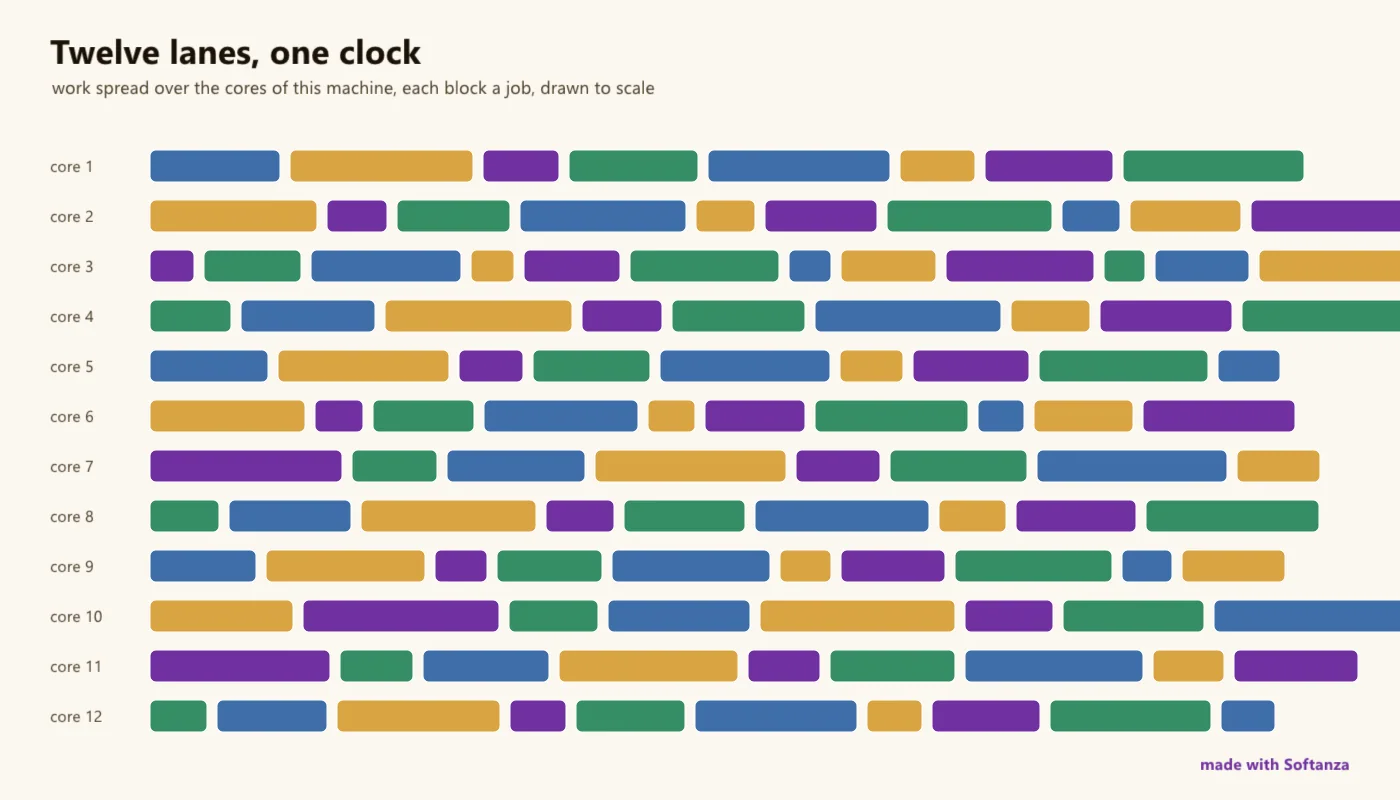
The engine sees this laptop's twelve cores. The cluster, fleet and multicore guards are this group's proof; here, the count.
? StzEngineSystemCpuCount()
12
run on 2026-10-01 at 01:40
The articles of this area (5)
- From Sequential Bottlenecks to Reactive Solutions: A Programming Journey 2025
- Softanza Reactive Programming Semantics: A Conceptual Framework 2025
- Softanza Reactive Objects: A Complete Beginner's Tutorial 2025
- Reaxis: A Natural Model for Reactive Programming in Haro, by Softanza 2025
- The Great Simplification: How Reaxis Dissolves Decades of Reactive Programming Complexity 2025
The lanes, one by one
Lanes and their notes are quoted as they were read at the source, on Read from the source on 2026-09-16, from a read-only main worktree.