

System programming
A governed-effects surface, not a Go or Rust standard-library clone: rehearse then commit; an LLM cannot act by construction.
1 Strong · 7 Solid · 3 Partial · 1 Emerging
Measured against: Go/Rust std · libuv · Folders: base/system(opens in a new tab) · base/platform(opens in a new tab) · For programmers: this area's reference
Rethought from first principles
What Softanza kept from what works, and what it rethought, as the library wrote it down in its design documents and narrations.
The Softanza wayOnly the engine touches the real system; everything above it is a view or a rehearsal, and reality changes only when a governed plan crosses the one door.
Kept from the best practice
- Direct action stays available: the real file, folder and process classes still act at once. Rehearsal is the recommended path for consequential change, not a forced one. source(opens in a new tab)
- Child processes are managed the usual way: spawn, stream the output, wait, read the exit code, stop. Closing a handle stops a running child, so nothing leaks. source(opens in a new tab)
- Building for another machine reuses Zig's cross-compiler: a deployment target's operating system and processor are simply the build triple. source(opens in a new tab)
Rethought
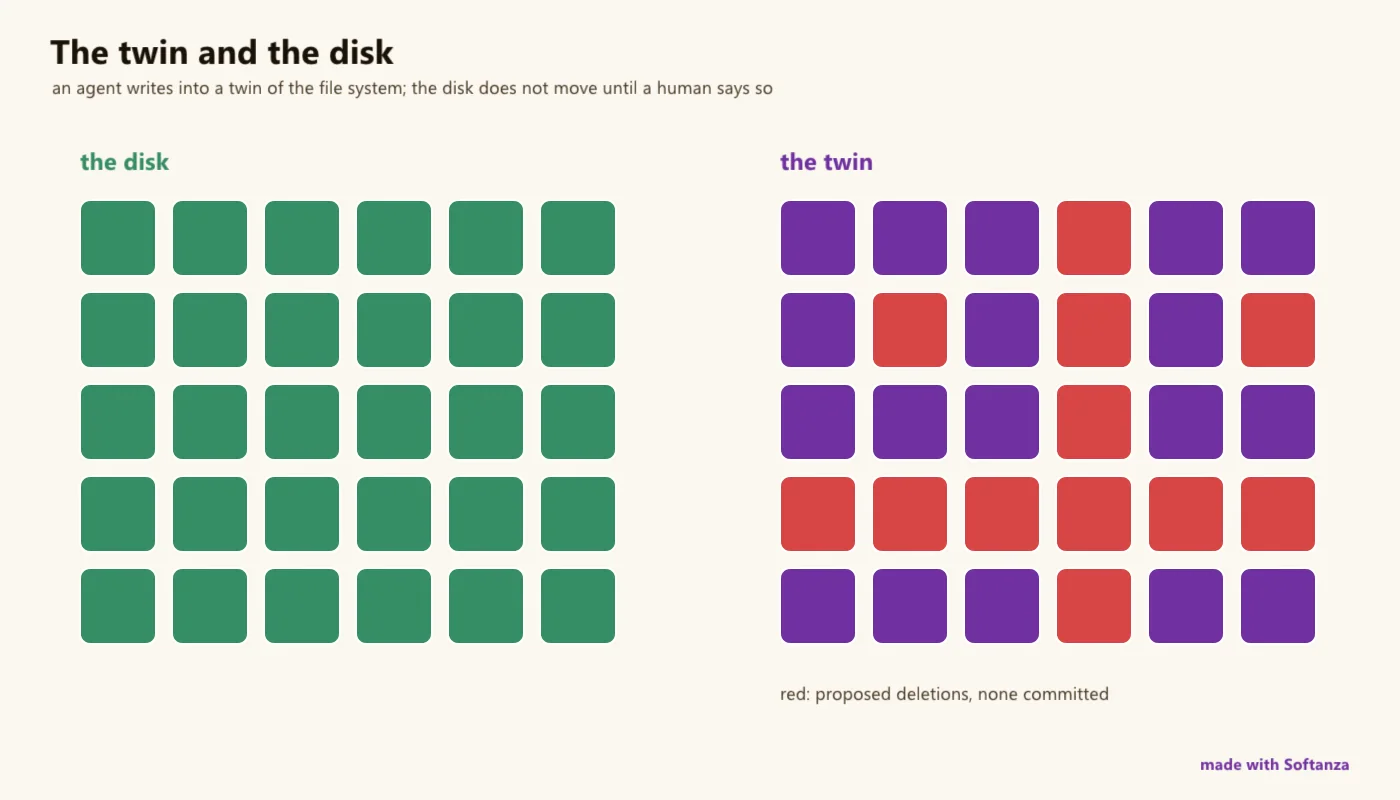
- Rehearse, plan, commit. Changes are tried in an in-memory twin that holds no reference to reality; an update plan is the only way they reach the real system. source(opens in a new tab)
- Imagining a change and enacting it are separate powers. A language-model actor holds no power to act, so it can propose a plan but never commit one. source(opens in a new tab)
- System code is written in a named scope: development, deployment or runtime. Code for a phone is checked against the phone, and a forbidden act is refused at write time. source(opens in a new tab)
- The twin also stands in for a machine you do not have: a microcontroller's pins are rehearsed on a laptop, then lowered to firmware source for the real device. source(opens in a new tab)
Deliberately not a Go/Rust-std system library: a clean but intentional subset of OS primitives, plus a layer none of them have -- an in-memory rehearsal twin over files, env and spawns, a single narrated/scoped/audited stzUpdatePlan that is the only bridge to reality, and a capability-actor lattice where an inference-only (LLM) actor's effect set is empty by construction. It omits by design what a governed-effects surface doesn't need: signals, broad IPC, the raw syscall zoo.
What a crafter does with it, and what stands out
- A rehearsal twin over files, env and spawns that touches nothing
- stzUpdatePlan: the sole crossing to reality, through three gates (reject, scope, governance)
- An inference-only (LLM) actor's effect set is empty by construction -- agents that cannot hurt you
- Deploy(:Production) gated by MayCommit; Git and LocalRepo backends proven byte-for-byte
What is owed
- Signal handling (SIGINT/SIGTERM/SIGCHLD and Windows console-control)
- The full async reactor surface
- Complete the process face (ExePath, IsAlive, process table); live-verify ssh/docker/device deploy backends
- Richer IPC and the lower OS surface (permissions, symlinks, users/groups); wire the engine sandbox flag
The Softanza way, run
What Softanza does differently in this area, shown by code taken from its narrations and guards, and run for this page.
File changes are rehearsed in an in-memory twin and come out as a plain-language plan; nothing on disk changes until the plan is committed.
oVfs = new stzVirtualFileSystem()
oVfs.CreateFolder("config")
oVfs.CreateFile("config/greenhouse.ini", "pump_threshold=40")
oVfs.MoveFile("old_settings.txt", "config/legacy.ini")
oPlan = oVfs.GenerateUpdatePlan()
? oPlan.Narration()Update plan (3 of 3 operations to commit): * 1. create folder 'config' * 2. create file 'config/greenhouse.ini' (17 bytes) * 3. move 'old_settings.txt' -> 'config/legacy.ini'
run on 2026-10-01 21:18 inside the library at commit 0e72e2e2c; taken from base/doc/narrations/stz-system-dev-to-deploy-narration.md(opens in a new tab)
The articles of this area (8)
- Your First Taste of Systems Programming - Without the Fear 2025
- Softanza's System Call : Built on the System Process API 2025
- From Dev to Deploy Without Leaving Your Editor 2026
- Deploying to the Target Sites 2026
- Emulating the Whole Solution 2026
- Planning and Provisioning a Deployment 2026
- Code First, Subscribe Later 2026
- The Engine Senses 2026
The lanes, one by one
Lanes and their notes are quoted as they were read at the source, on Read from the source on 2026-09-16, from a read-only main worktree.